Bike Rental Solutions
 Courier Delivery Management
 Clinic Management Software
 Property Management Software
 Food Delivery App Development
 Travel and Hospitality App Development
 On Demand Grocery Delivery
 Telemedicine App Development
 Truck Dispatch Software Development
 Car Wash App Development
 Home Services App Development
 Fintech Software Development Companies


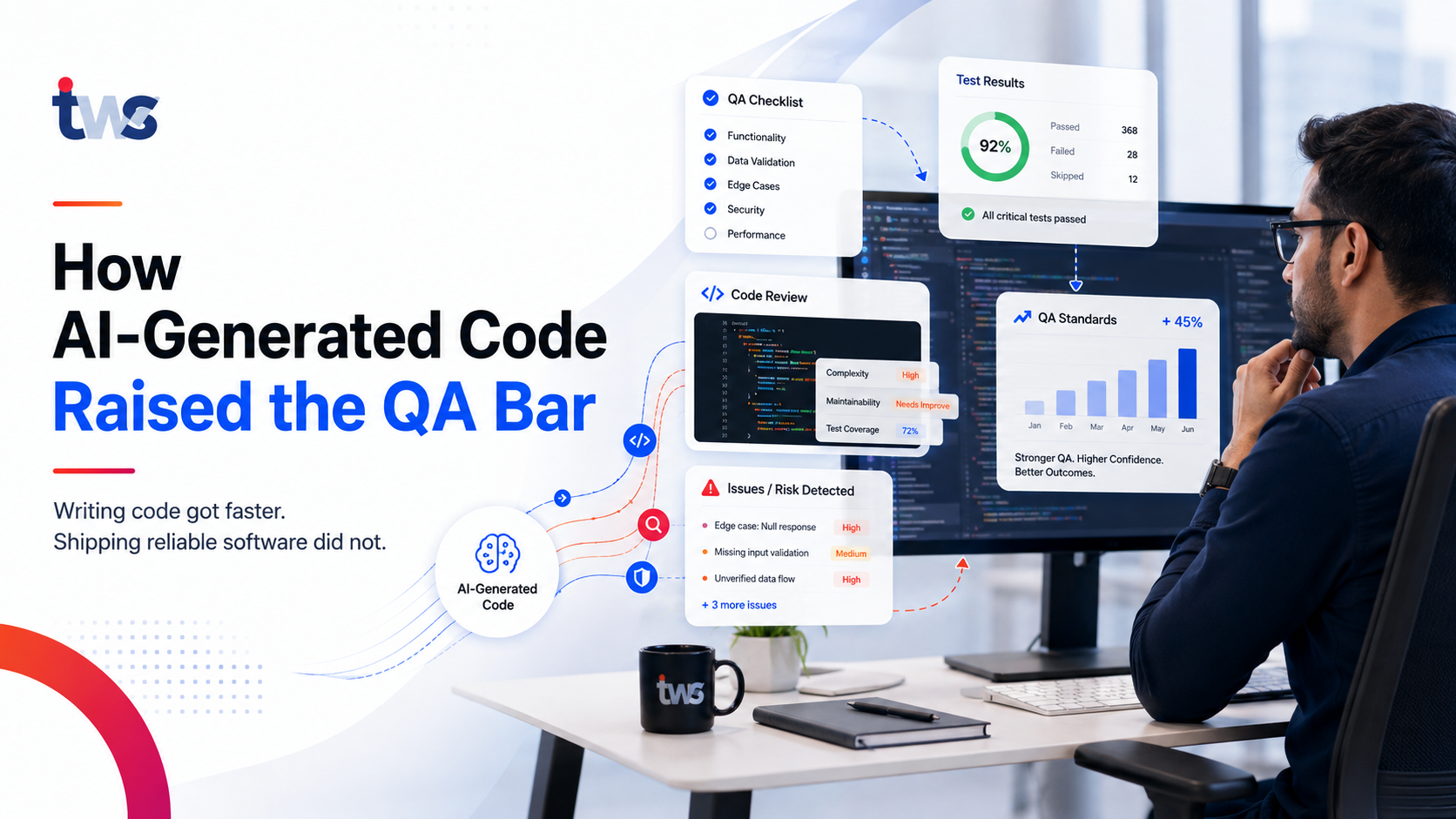
Writing code got faster. Shipping reliable software did not.
Over the past two years, AI coding assistants have gone from novelty to default. Most professional developers now use an AI tool somewhere in their workflow (Stack Overflow Developer Survey, 2024), and the volume of code moving through pull requests has climbed accordingly. That sounds like a win for engineering velocity, and in a narrow sense it is. But for the teams responsible for making sure that code actually works, the AI shift has not reduced the workload. It has relocated it.
Quality assurance used to be the step that happened after most of the risk was already resolved by a human writing careful code. Now it is often the first place anyone rigorously checks whether the logic holds up at all. That change is forcing enterprises and mid-sized software teams to rethink how much QA capacity they need, what kind of QA talent they need, and whether building that capacity in-house still makes sense.
Table of Contents
Why AI-generated code shifted the bottleneck to QA
AI coding tools are very good at producing code that looks correct. Syntax is clean, patterns are familiar, and functions often run without errors on the first try. What they are not reliably good at is understanding the specific business logic, edge cases, and prior decisions baked into a particular product. A generated function can pass a quick manual glance and still mishandle a currency rounding rule, an authorization check, or a rare but critical user path that nobody explicitly described in the prompt.
The result is more code arriving for review, produced faster, with a wider and less predictable range of subtle defects. Traditional QA processes were built around a steadier pace of human-written code, where a smaller number of experienced engineers had already caught the obvious mistakes. That assumption no longer holds. Testing teams are now the primary checkpoint for catching problems that used to be filtered out earlier in the process, which means QA has to do more, not less, even as the code review clock keeps compressing.
A common failure mode looks like this: a feature branch built partly with AI assistance passes its unit tests and clears code review because nothing looks obviously wrong. It ships. Weeks later, a support ticket traces a billing discrepancy back to a rounding rule the generated code handled differently than the rest of the codebase, in a spot nobody thought to write a test for because it wasn’t an obvious risk area before. Multiply that scenario across dozens of pull requests a week, and it becomes clear why more testing volume alone doesn’t solve the problem. The testing has to get smarter about where the new risk actually lives.
From script execution to risk judgment
This pressure is also changing what a QA role actually requires. Manually clicking through a fixed test script, or running an automated suite someone else designed years ago, catches the failures everyone already anticipated. It does very little against a defect pattern that didn’t exist before AI-assisted development became common.
The QA engineers holding up best under this shift are the ones who can look at a pull request and ask the harder question: what did this change actually touch, and what’s the blast radius if it’s wrong? That requires product context, not just testing mechanics. It’s part of why job descriptions for QA and test engineering roles increasingly emphasize risk judgment and product understanding over pure test-execution experience.
The build-or-outsource decision gets more urgent
For a lot of enterprises and growth-stage companies, this shift arrives at an awkward moment. Hiring and training QA engineers who can reason about product risk, not just run scripts, takes time most teams don’t have while AI-generated code volume keeps climbing. That’s pushing more organizations to look at QA outsourcing as a way to add tested, senior testing capacity without a multi-month hiring cycle.
Not all outsourced QA models solve the actual problem, though. A vendor that treats testing as a disconnected, ticket-based service can end up in the same position as an under-resourced in-house team: reviewing code without enough context to catch what matters. The outsourcing models built around embedding QA engineers directly into a product team, rather than routing tickets through a detached testing queue, tend to hold up better here, since the tester actually develops the product familiarity that risk-based testing depends on. Full Scale’s embedded QA outsourcing model is one example of this approach, pairing dedicated QA engineers with a client’s existing team so testing decisions are grounded in how the product actually works rather than a generic checklist.
 What to evaluate in a QA outsourcing partner
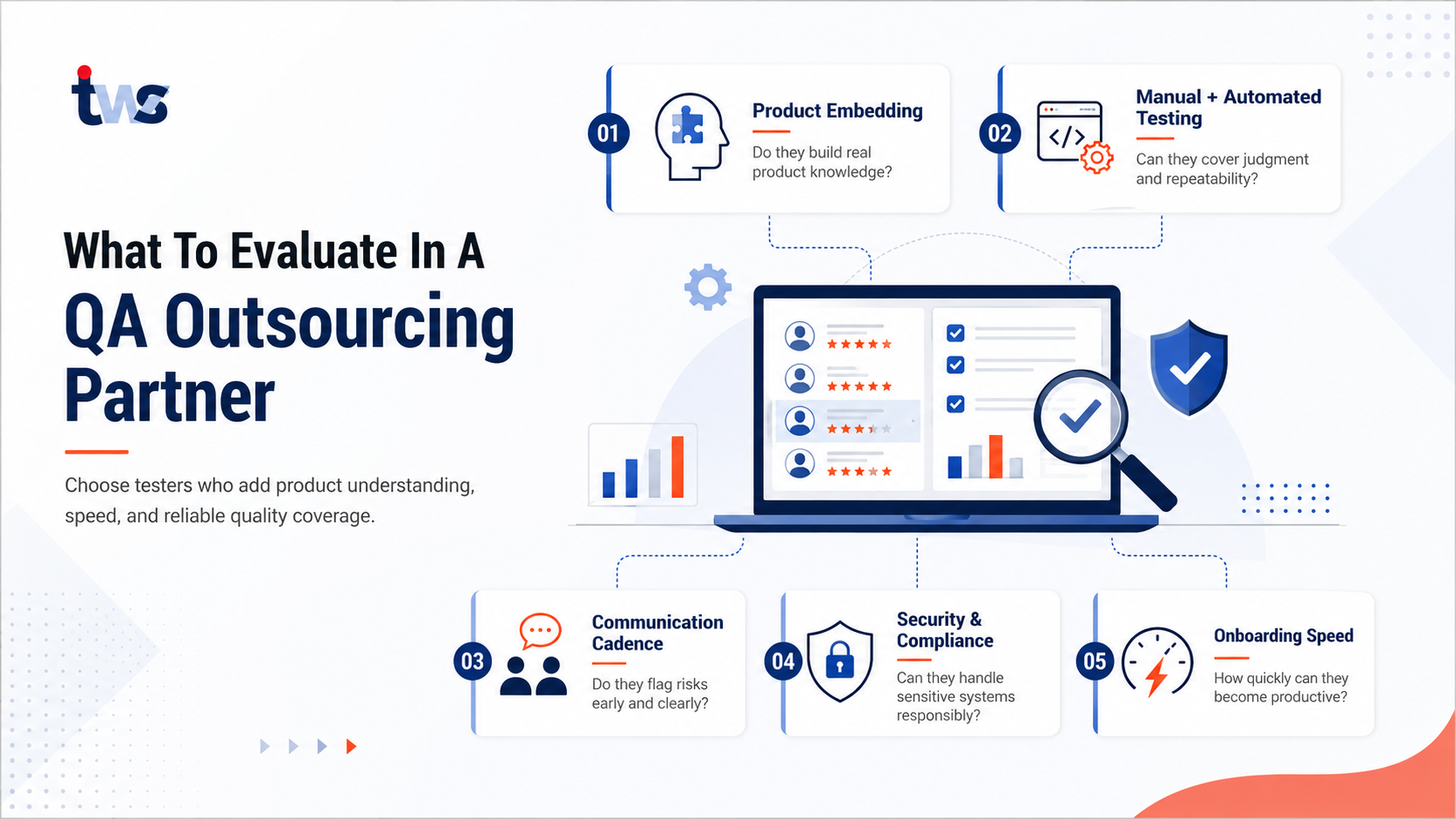
Whether a company is comparing outsourcing models or vetting individual vendors, a few criteria matter more now than they did before AI-assisted development became the norm:
- Product embedding, not ticket routing. Ask whether testers work inside the team long enough to build real product knowledge, or whether they’re rotated across unrelated projects.
- Coverage of both manual and automated testing. AI-era defects often show up in judgment calls that automation won’t catch on its own, so a partner needs strength in both.
- Communication cadence. Testers who can flag a risky pattern early, in plain language, save far more time than testers who only report pass/fail at the end of a cycle.
- Security and compliance familiarity. As testing scope grows, so does exposure to sensitive data and systems; a partner should already operate under clear data-handling practices.
- Onboarding speed. Since the whole point of outsourcing is to add capacity quickly, a vendor that takes months to get a tester productive undercuts the reason to outsource in the first place.
None of these criteria are new in principle. What’s changed is how much weight they carry. A testing partner that was merely adequate before AI-assisted coding became widespread, one that ran scripts and filed tickets without digging deeper, is now a much bigger liability, because the defects slipping through are less predictable and more expensive to trace after the fact.
The bigger picture
AI didn’t make software quality easier to guarantee. It made the volume of code needing quality judgment larger, faster-moving, and less predictable. Enterprises that treat QA as a fixed-size afterthought are going to feel that pressure first. The ones adapting well are the ones treating testing capacity, whether in-house or outsourced, as a resource that has to scale alongside the amount of AI-assisted code moving through their pipeline, not a step bolted on at the end.